The Summo Notes team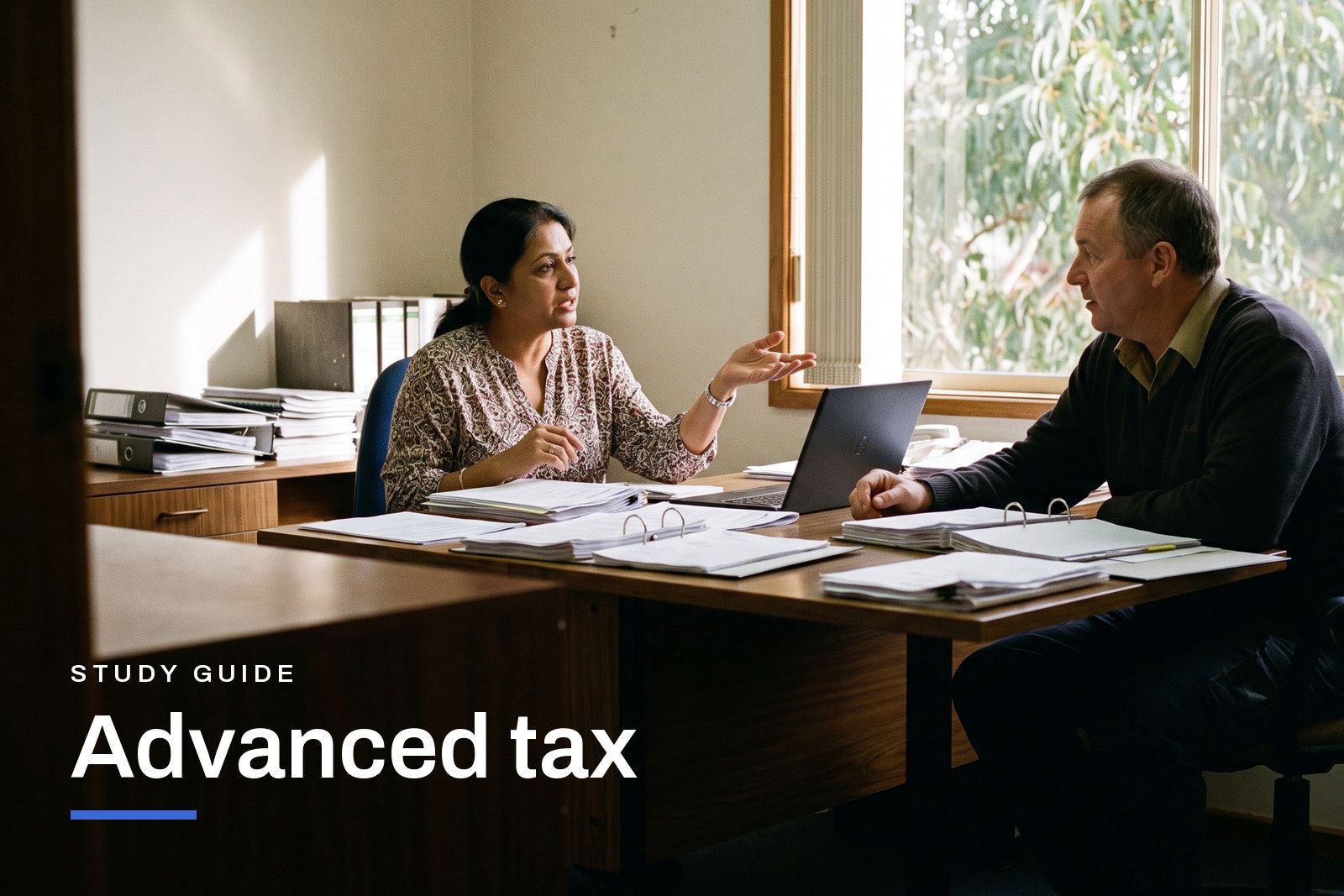
Advanced Tax in the CA Program applies the machinery from the core Tax subject to the harder questions a client actually brings: remuneration, property, structures, financing and cross-border transactions. There is no exam. It is assessed by one submission in two parts, a written response worth 80 per cent and a recorded presentation worth 20 per cent, handed in together in the final week. The marks are in the advice, so the frame to learn is treatment, then implications, then recommendation.
On this page
The short version
- Advanced Tax builds on the core Tax subject, which is a prerequisite. It assumes that machinery from day one.
- Two chapters. The first is short. The second, structures and transactions, carries most of the subject.
- There is no exam. One submission, written 80 per cent and a recorded presentation 20 per cent, both due in the final week.
- The marks are in the advice, not the rule. Treatment, then implications, then recommendation.
- It runs in two streams, Australian and New Zealand. Answer inside the law of your own stream.
What you are up against
Advanced Tax is the subject where the rules stop being the answer. You already know the machinery, because the core Tax subject is a prerequisite and this one assumes it from the first week. What it asks is different: here is a taxpayer, here is a messy situation, tell them what it means and what to do.
That changes what preparation looks like. There is nothing to sit and pass at the end, so there is no cramming week and no exam technique to drill. There is one submission, and it is built over the study period rather than answered in three hours. The work is learning to write advice that holds up.
Two chapters, and they are not the same size. The first covers employment remuneration, property and assets, and the subject itself calls it short. The second covers tax structures, financial transactions, and international and cross-border transactions, and it carries the subject. The study plan gives structures two weeks on its own and everything else one, which tells you where the hours go before you have read a page.
Advanced Tax is an elective, so you have chosen it. All thirteen CA Program subjects are set out together if you are still deciding the rest.
Where the hours go
The subject’s own shape tells you the answer, so you do not have to guess. Chapter two is described as the heart of the subject and gets three deep topics against chapter one’s two. Structures alone is allocated two weeks. And the assessment marks advice to a named taxpayer, so a topic that generates a real advice question outranks one that does not.
Relative emphasis across the advanced tax topics, based on the subject structure
Where we would spend the study hours, based on the subject structure. Not published assessment data.
Two things about that chart are worth saying out loud. The advice frame is not a syllabus topic, and it is on there because eighty per cent of your mark is a written piece of advice. And the first chapter sits at the bottom not because it is unimportant but because it is short and the subject says so.
One submission, two parts
There is no exam here, and nothing you have to pass on its own. That removes a familiar kind of pressure and replaces it with a different one: everything rests on a single piece of work, and it is due in the final week with no second attempt sitting behind it.
The written part is eighty per cent. You are given a scenario about a complex tax issue and a specific type of taxpayer, and you write the response. The marking is criteria-based, so the shape of the answer matters as much as the content. Name the taxpayer and their structure, work the treatment, state the implications, then recommend. An answer that stops after the treatment has done half the job and earns roughly half the marks.
The presentation is twenty per cent, and it is where people underestimate the work. You pick an element of your own written response and present it to a named stakeholder group. The marking is on communicating complex tax clearly to that group. It is not a summary of your submission read aloud. Different audience, different job.
Tip
Plan the presentation while you draft the written part, not after. Choosing which element to present is easier when the argument is still in your head, and it usually improves the writing, because the piece you can explain out loud in a few minutes is the piece you actually understand.
The advice frame
Almost every mark in this subject runs through one structure, and it is worth building it into a habit before you meet a scenario.
Treatment is the half most candidates do well, because it is the half that looks like the core subject. Implications is where the marks move. It is the step that turns an analysis into something a taxpayer can act on: what it costs, when it falls due, what obligation it creates, what changes if they do nothing. Recommendation follows from implications and is short when the first three steps are done properly.
Exam trap
The most expensive habit in this subject is answering the rule instead of the taxpayer. The scenario names a specific type of taxpayer for a reason, and a technically correct answer written about a generic case does not fit them. Read the taxpayer description twice before you write anything.
Structures, and why the label is not the answer
Chapter two opens on tax structures and it is the deepest topic in the subject, which is why the plan gives it two weeks. The thing that separates a strong answer from a weak one is that a structure is not its name. A trust is not a treatment. What matters is how the arrangement actually operates: who holds what, where the income lands, who bears it, what the documents say happens.
That is also what makes a comparison question work. When a scenario asks whether the current structure suits a new activity, the answer is not a description of each option in turn. It is the difference between them, for this taxpayer, on these facts.
Financial transactions and cross-border sit alongside it in the same chapter. Both reward the same discipline of working from what is actually happening rather than from the label attached to it. Cross-border adds one habit worth fixing early: residence and source come first, before anything else, because they decide what can be taxed at all.
How to study this subject
The prerequisite matters more here than in most subjects. Advanced Tax assumes the core Tax machinery from week one and does not revisit it, so if the core subject was a while ago, spend the first week checking it rather than discovering the gap in week four.
After that, study by writing. This subject is assessed on a piece of writing, so reading about structures builds none of the skill it marks. Take a scenario, work it, write the advice to the frame, and then check the draft against the frame rather than against a model answer word for word. Every draft is a rehearsal of the thing you are actually assessed on.
Tip
Keep a running note of anything carrying a rate, a threshold or a year. Those are the parts most likely to have moved, and they are also the parts a reader can check fastest, so a stale figure costs more than it should.
Your Advanced tax study checklist
0 of 8 doneChapter two is where the subject lives. Progress saves in your browser.
Traps that cost easy marks
The four that catch people
Answering the rule instead of the taxpayer, when the scenario named one for a reason. Stopping at the treatment and never reaching the implications, which is where the marks build. Treating a structure as a label rather than working how it operates. And answering outside your stream, when the Australian and New Zealand law differs on financial and cross-border topics. Every one is a reading habit rather than a knowledge gap.
The treatment tells the taxpayer what the law does. The implications tell them what it costs them. Only the second one is advice.
Questions people ask about Advanced tax
- How is this different from the core Tax subject?
- The core subject teaches the machinery of the tax system. This elective applies it to complex issues and marks you on the advice rather than the recall. It assumes the core subject from day one, because it is a prerequisite.
- Is there an exam?
- No. The subject is assessed by a single submission with a written part and a recorded presentation, handed in together in the final week. There is nothing to pass on its own.
- Australian or New Zealand tax?
- Both. The subject runs in two streams and you follow the stream of your core Tax subject. The streams differ most in the financial and cross-border topics, so answer inside your own.
- What do I need before I start?
- Two prerequisites: an ethics subject, and the core Tax subject in your stream. The second one matters day to day, because this subject assumes that machinery and does not teach it again.
- How much time should I budget?
- The subject runs over a seven-week study period and expects about ninety-five hours, roughly fifteen hours a week across six teaching weeks plus the assessment. Structures alone takes two of those weeks.
Want the advice frame already on a page?
Our Advanced tax pack puts the treatment, implications and recommendation frame on a page, with worked cases that run a scenario through to a recommendation and structure guidance for the written submission and the presentation. Your time goes on practice, not on making notes.
If this helped, three more will too. Start with the Tax study guide for the machinery this subject assumes, then how to read a question stem for the command verbs that decide what an answer needs, and how to find the topics that carry the marks.