The Summo Notes team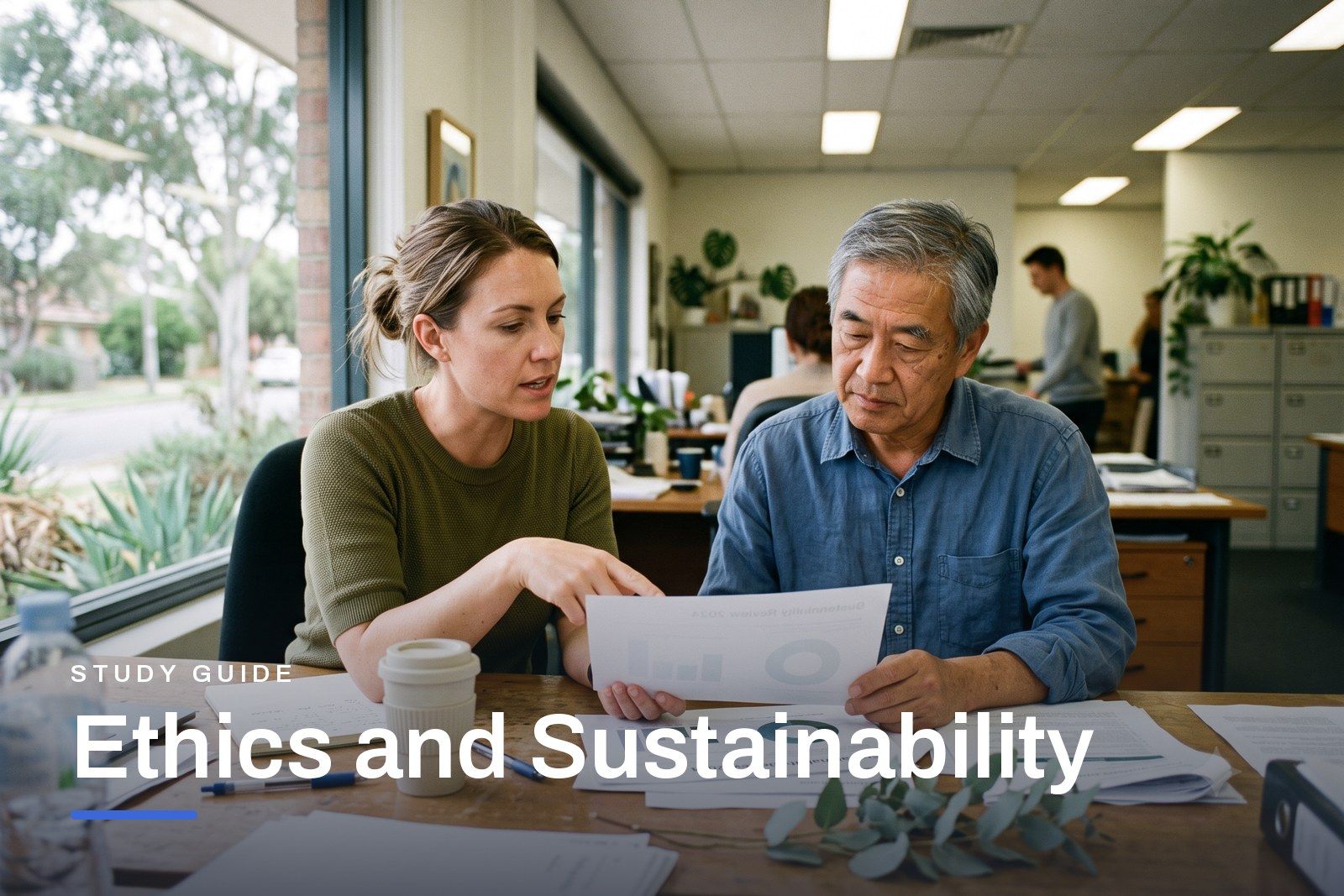
Ethics and Sustainability in the CA Program is assessed through a group workshop that includes a recorded presentation, rather than an invigilated exam, so the skill is reasoning you can explain and defend out loud. One framework runs the ethics half: identify the threat to a principle, evaluate how significant it is, then address it. The sustainability half is newer and moving, so confirm the current subject outline and the frameworks that apply to your sitting.
On this page
- What you are up against
- Where your effort goes
- The assessment is a group task, so prepare for that
- Ethics: one framework does most of the work
- Sustainability: newer, and moving
- The topics that decide your result
- How to study this subject
- Traps that cost easy marks
- Questions people ask about Ethics and Sustainability
The short version
- Ethics and Sustainability is a core subject, and it is assessed by a single group workshop, including a recorded presentation, with no exam.
- One framework runs the whole ethics half: identify the threat to a principle, evaluate how significant it is, then address it.
- The sustainability half is about what accountants report on the environment and society, and the rules there are new and moving.
- Because the assessment is a group task, doing well means reasoning you can defend out loud and working effectively with others.
- The most common ethics slip is siding with the person asking instead of the public interest.
What you are up against
This subject is short on content and long on judgement, and it is assessed in a way that catches people off guard: there is no exam. The whole subject is assessed through a group workshop, including a recorded presentation. So the skill is not recalling a rule under invigilation. It is reasoning through an ethical problem clearly enough to explain and defend it to others, and doing that as part of a group.
The content has two halves. The first is ethics, and it is smaller than it looks, because almost all of it runs on a single framework you can learn in an afternoon and then apply for the rest of your career. The second is sustainability, which is newer and more of a moving target, because what accountants are asked to report about the environment and society is changing quickly. Learn the ethics method cold, and keep the sustainability side current.
Ethics and Sustainability is one of the seven core subjects, so it is on your list either way. Every one of the CA Program subjects is set out together if you are still planning your order.
Where your effort goes
With no exam, the question is where your preparation pays. The ethics framework is the core, because you use it in every ethical scenario. Sustainability is the growing half and rewards current knowledge. Your professional foundations sit underneath, quicker to cover but worth knowing.
Relative emphasis across the three chapters, based on the subject structure
Where we would spend the study hours, based on the subject structure. Not published assessment data.
The plan is simple. Learn the ethics framework until applying it is automatic, because it is the one thing you use every time. Get current on sustainability reporting, because vague or dated answers earn little. Cover the professional foundations well enough to speak to them, and put your remaining time back into the framework.
The assessment is a group task, so prepare for that
The whole subject is assessed through a group workshop, including a recorded presentation, and there is no exam or hurdle to sit alone. That changes what good preparation looks like. You are not revising to recall facts at speed. You are getting to the point where you can reason through an ethical problem clearly, explain it to others, and hold a position under a follow-up question.
Because it is a group task, the ordinary group rules apply and they matter for the mark. Agree how you will divide the work, keep a record of what you decide, and leave time to rehearse the presentation together rather than stitching it together at the end. The content is only half of it. Being able to present a clear, defensible judgement as a group is the other half.
Ethics: one framework does most of the work
Professional ethics rests on a small set of fundamental principles: acting with integrity, staying objective, keeping your competence up and taking due care, protecting confidential information, and behaving professionally. You do not weigh these case by case from scratch. Instead there is a single method for handling any situation that puts one of them at risk, and learning that method is most of the subject.
The method has three steps. Identify the threat to a principle, and there is a short list of the kinds of threat, such as acting in your own interest, reviewing your own work, advocating for a client, being too close to someone, or being pressured. Evaluate how significant the threat is. Then address it, either by applying a safeguard that reduces it to an acceptable level, or by declining the work if it cannot be reduced. Run any ethical scenario through those three steps and you have the shape of a strong answer.
Exam trap
The classic ethics slip is siding with the person in front of you. A client or a colleague asks for something that feels reasonable, and sympathy pulls you toward saying yes. The tie-breaker is the public interest, not the relationship. Name the principle and the threat, evaluate honestly, and let that decide, even when it is the harder answer.
Sustainability: newer, and moving
The sustainability half asks what accountants report about a business beyond its finances, in particular its effect on the environment and its exposure to environmental risk. This area is developing fast. New reporting requirements for climate-related information are being phased in, so what a business must disclose, and from when, depends on the rules in force and the size of the business. Because it is moving, treat any date, threshold or requirement as something to verify against the current position rather than trusting older notes.
Exam trap
A common sustainability slip is accepting an environmental claim too easily, for instance approving it because competitors make the same claim. An overstated or unsupported environmental claim is a problem in its own right, and it is often an ethics issue as much as a reporting one. Test the claim against the evidence, not against what others are doing.
The topics that decide your result
How to study this subject
Study this one by reasoning out loud, because that is what the assessment asks for. Reading the principles teaches you to name them. Talking through real dilemmas, and defending your view, teaches you to apply the framework and hold a position, which is the skill on show in a group presentation.
Run practice scenarios through the three steps until the method is second nature, and get comfortable being challenged on your answer, since a recorded group presentation invites exactly that. Keep a short, current file on sustainability reporting so your examples are up to date. And prepare the group work properly: clear roles, a record of decisions, and rehearsal time, because the presentation is where your reasoning either lands or does not.
Your Ethics and Sustainability study checklist
0 of 7 doneWork top to bottom. The framework comes first for a reason. Progress saves in your browser.
Traps that cost easy marks
The three that catch people
Siding with the person asking instead of the public interest. Accepting an environmental claim because others make it, rather than testing it against the evidence. And treating the group presentation as a content task alone, when how clearly and defensibly you present is half of it. Every one is a judgement or preparation slip, not a knowledge gap.
One method runs the whole ethics half: identify the threat, evaluate it, and address it, with the public interest as the tie-breaker.
Questions people ask about Ethics and Sustainability
- Is there an exam in this subject?
- No. Ethics and Sustainability is assessed through a single group workshop, including a recorded presentation, with no invigilated exam. The skill to build is reasoning through an ethical problem clearly and presenting it, rather than recalling rules at speed. Confirm the structure against your current subject outline.
- What is the ethics framework?
- A single three-step method: identify the threat to a fundamental principle, evaluate how significant it is, then address it with a safeguard or by declining the work. Almost every ethical scenario runs on it, so learning it well covers most of the ethics half.
- How do I approach an ethical dilemma?
- Name the principle at risk and the kind of threat, evaluate it honestly, and let the public interest be the tie-breaker rather than sympathy for the person asking. Then choose a safeguard or decline. Working to that shape is what earns the marks.
- What do I need to know about sustainability reporting?
- What accountants report about a business beyond its finances, and how new climate-related requirements are phasing in. It is a moving area, so keep your knowledge current and verify any date or threshold against the rules in force for your sitting.
- How do I do well in the group assessment?
- Prepare the content and the group work. Agree roles early, keep a record of decisions, rehearse together, and be ready to defend your reasoning when questioned. Clear, defensible judgement presented well is what earns the marks.
Want the framework and the reporting on a page?
Our Ethics and Sustainability notes put the ethics method, the threats and safeguards, and the sustainability reporting picture in one clear set, with worked examples that show the reasoning. Your time goes on judgement, not on making notes.
If this helped, two more will too. Start with how to find the topics that carry the marks to size up any subject quickly, then how to read a question stem for the command verbs that decide what an answer needs.