The Summo Notes team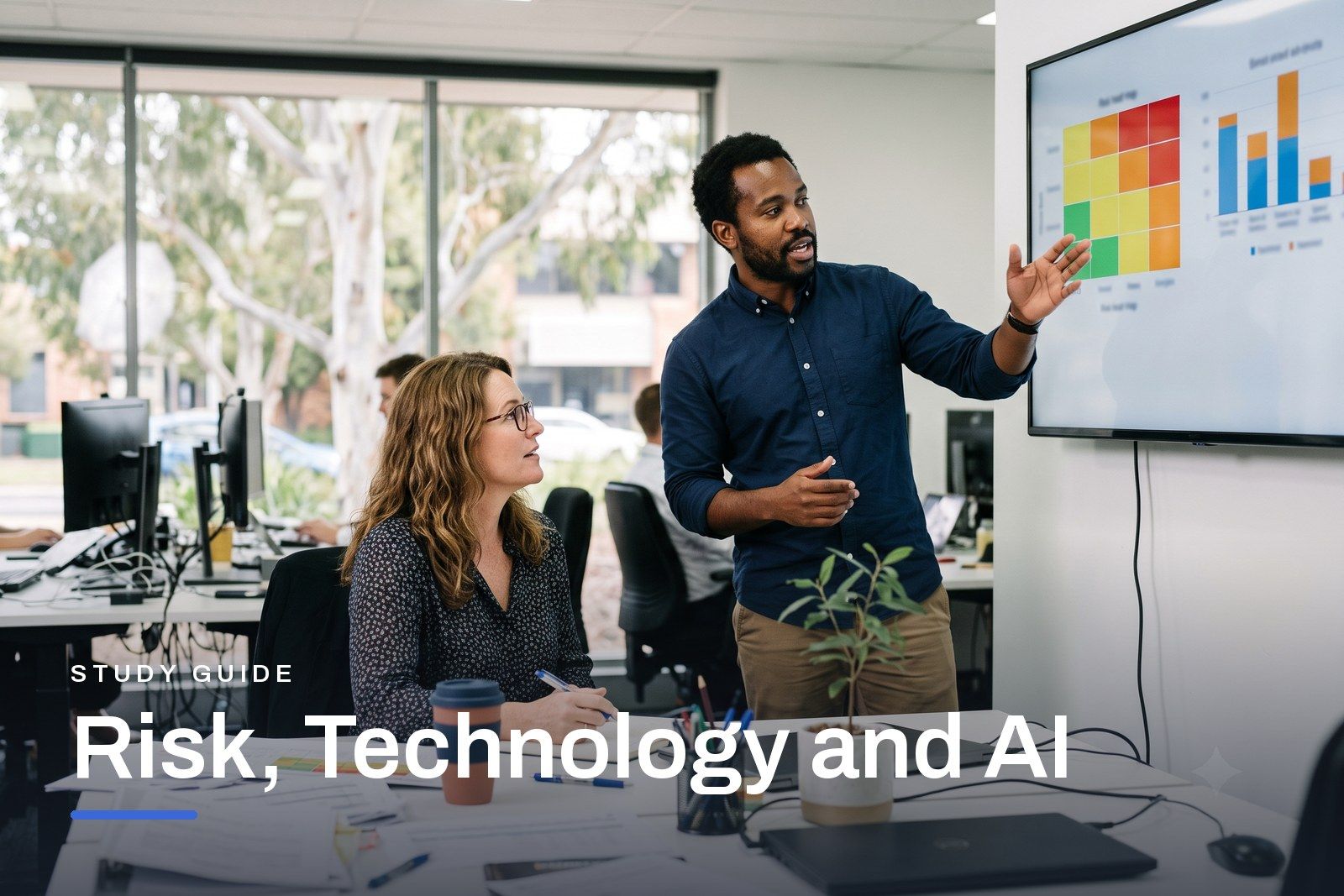
Risk, Technology and AI in the CA Program is assessed by two case-based written submissions with no invigilated exam, so marks are won on the page rather than under time pressure. Risk management is the spine: describe a risk as a cause, an event and an effect, score it by likelihood and consequence, then treat it. The other half is what technology and artificial intelligence change for a business, what they put at risk, and how they should be governed.
On this page
- What you are up against
- Where the submissions focus
- Two written submissions, and how they are marked
- Risk management: the method that runs the subject
- Technology and artificial intelligence
- The topics that decide your result
- How to study this subject
- Traps that cost easy marks
- Questions people ask about Risk, Technology and AI
The short version
- Risk, Technology and AI is a core subject, and it is assessed by two written submissions with no exam at all.
- Both submissions are case-based, so the skill is reading a scenario, working out what matters, and writing a clear, reasoned answer.
- Risk management is the spine. A risk is described as a cause, an event and an effect, then scored by likelihood and consequence, then treated.
- Technology and AI are the modern half: what they change, what they put at risk, and how a business should govern them.
- Because there is no exam, marks are won or lost on the page, so writing to the marking criteria matters as much as knowing the content.
What you are up against
This subject is different in one way that changes how you prepare: there is no exam. Both assessments are written submissions, so you are never tested for speed under invigilation. You are tested on whether you can read a business scenario, identify what matters, and write a clear, reasoned answer. That is a good thing if you plan for it, because a written answer rewards structure and thinking, and both of those you can build in advance.
The content sits in two halves. One is risk management, which is a method for finding, sizing and handling the things that could go wrong. The other is technology and artificial intelligence, which is about what these tools change for a business, what they put at risk, and how they should be governed. The subject asks you to bring the two together: to look at a business using technology and say, clearly, where the risks are and what to do about them.
Risk, Technology and AI is one of the seven core subjects, so it is on your list either way. Every one of the CA Program subjects is set out together if you are still planning your order.
Where the submissions focus
With no exam, the useful question is not where the exam marks sit but where the two submissions concentrate. Risk management carries the most, because it is the method the whole subject leans on. Technology and artificial intelligence are the modern differentiator and reward specific, current thinking. Governance and disclosure tie the two to what a business has to report.
Relative emphasis across the four chapters, based on the subject structure
Where we would spend the study hours, based on the subject structure. Not published assessment data.
The plan is to make the risk method automatic first, because both submissions use it. Then get current and specific on technology and artificial intelligence, because vague answers there earn little. Then connect both to governance and disclosure, which is how a business is held to account for how it manages risk and technology.
Two written submissions, and how they are marked
Both assessments are written submissions against a case, worth 40% and 60%. There is no invigilated exam, and no hurdle exam to pass on its own. That shifts where your effort goes. You are not preparing to recall facts at speed. You are preparing to read a scenario, plan an answer, and write it clearly enough that the reasoning is visible and the marks are there to award.
Because the marking is criteria-based, the shape of your answer matters as much as the content. A short plan before you write keeps every part of the question answered and stops you burning words on the wrong thing. Then write in a way that maps to what is being marked: identify the risk, size it, propose a treatment, and justify it. The model answers in good practice materials are there to show that shape, not to be copied.
Tip
Spend the first few minutes planning, not writing. List what the question is actually asking for, then draft an answer that hits each part in order. A short plan saves words later and stops you missing a requirement, which is the easiest way to leave marks on the table in a written submission.
Risk management: the method that runs the subject
A risk is not just a bad thing that might happen. Described well, it is a cause that could trigger an event that would have an effect on the business, and writing it that way is what lets you do anything useful with it. Once a risk is described, you size it by combining how likely it is with how bad it would be, on a consistent scale, so that different risks can be compared and ranked.
Then you decide what to do about it. There are four honest options: avoid the activity, reduce the risk with a control, transfer it to someone else such as an insurer, or accept it knowingly. The mark is not in naming the option, it is in choosing one that fits the score and saying why. A small, unlikely risk that you spend heavily to avoid is as wrong as a severe one you quietly accept.
Exam trap
The most common submission error is listing risks without sizing or treating them, so the answer reads as a worry list rather than an analysis. Score each risk and pair it with a treatment and a reason. One well-quantified risk, handled properly, earns more than ten named in passing.
Technology and artificial intelligence
The second half of the subject asks you to think about what technology does to a business and its risks. Automation, distributed ledgers, the way data is stored and moved, and analytics each change how a business runs and where it is exposed. Artificial intelligence goes further, because it can make or shape decisions, which raises questions about how it is governed, where its data comes from, and who is accountable when it is wrong.
The marks here go to specific, current thinking, not general enthusiasm. Saying a technology is useful earns little. Saying what it changes for this business, what new risk it introduces, and how that risk should be governed is the answer the case wants. Because this area moves quickly, keep your examples current and check anything you state about a standard or a rule against the version in force.
The topics that decide your result
How to study this subject
Because both assessments are written, study by writing. Reading about risk teaches you the words. Working a case and writing it up teaches you the skill the submissions actually reward. Take practice scenarios, plan an answer, and write it to the shape the criteria call for, then check it against them rather than against a model answer word for word.
Drill the risk method until describing, scoring and treating a risk is automatic, because it is the move you make most. Keep a small, current file of technology and artificial intelligence examples you understand well enough to write about specifically. And practise planning before you write, because in a written submission a missed requirement is the easiest mark to lose and the easiest to prevent.
Your Risk, Technology and AI study checklist
0 of 7 doneWork top to bottom. The risk method comes first for a reason. Progress saves in your browser.
Traps that cost easy marks
The four that catch people
Listing risks without sizing or treating them, so the answer is a worry list. Being vague about technology instead of specific to the business. Skipping the plan and missing a requirement in the question. And writing without an eye on the marking criteria, so good thinking does not land where the marks are. Every one is a writing or process slip, not a knowledge gap.
With no exam, the marks are won on the page. Plan the answer, then write to what is being marked.
Questions people ask about Risk, Technology and AI
- Is there an exam in this subject?
- No. This subject is assessed by two written submissions, worth 40% and 60%, with no invigilated exam. That means the skill to build is reading a case and writing a clear, reasoned answer, rather than recalling facts at speed. Confirm the structure against your current subject outline.
- How are the submissions marked?
- Against criteria for a case-based answer. The shape of your response matters: identify the issue, size it, propose a treatment or response, and justify it. Writing to the criteria is as important as knowing the content.
- What is the most important thing to learn?
- The risk method: describe a risk as a cause, event and effect, score it by likelihood and consequence, and choose a treatment with a reason. Both submissions lean on it, so make it automatic first.
- How do I handle the technology and AI part?
- Be specific and current. Say what a technology changes for the business in the case, what risk it introduces, and how it should be governed. General praise for a tool earns little, and this area moves quickly, so keep your examples up to date.
- How should I study without an exam to sit?
- Study by writing. Work practice cases, plan the answer, write it to the marking shape, and check it against the criteria. The submission is the skill, so practise the submission.
Want the risk method and cases ready to work?
Our Risk, Technology and AI pack puts the risk method on a page, with a case pack of worked examples and a practice workbook mapped to the two assessment points. The worked answers show what a strong written answer looks like, so your time goes on practice.
If this helped, two more will too. Start with how to find the topics that carry the marks to size up any subject quickly, then how to read a question stem for the command verbs that decide what a written answer needs.