The Summo Notes team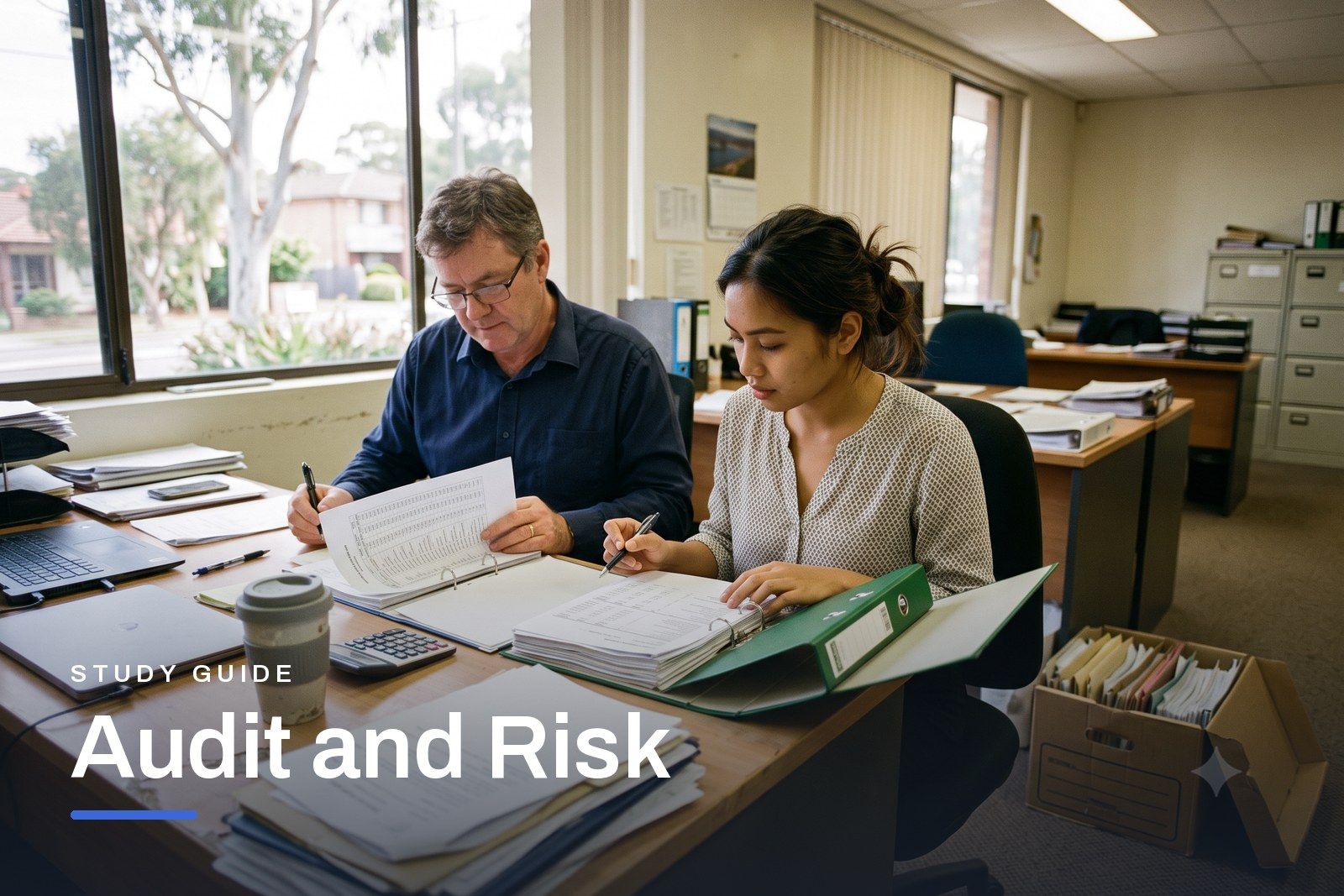
Audit and Risk in the CA Program follows the shape of a real audit: plan it, perform it, finalise it. It is assessed by a written submission, a workshop and a final invigilated exam, which must be passed on its own. The audit risk model is the spine of the subject, and it is a way of deciding where to look rather than a sum to compute. Marks go to showing that risk drove the work and the work drove the opinion.
On this page
The short version
- Audit and Risk is a core subject, and it follows the shape of a real audit: plan it, perform it, finalise it.
- It has three assessment points, a written submission worth 30%, a workshop worth 10%, and a final invigilated exam worth 60% that you have to pass on its own.
- The audit risk model is the spine of the whole subject. It is a way of thinking about where to look, not a sum to compute.
- Most marks are about judgement: how risk drives the work, what evidence answers a question, and which opinion the facts support.
- Most lost marks come from mechanical thinking: treating risk as arithmetic, or reading a single finding as a verdict.
What you are up against
Audit looks like a set of procedures to memorise, and that is the wrong picture. The procedures matter, but the subject is really about judgement: deciding where the risk of a material error is highest, doing the work that responds to it, and forming a defensible opinion. Listing steps earns little. The marks are in showing that risk drove the work and the work drove the conclusion.
The subject has a clean shape that helps you. An audit runs in three stages, plan, perform, finalise, and almost everything you learn slots into one of them. Once you can see how a topic fits that flow, from the first risk assessment to the wording of the opinion, the pieces stop feeling like a list and start feeling like a process.
Audit and Risk is one of the seven core subjects, so it is on your list either way. Every one of the CA Program subjects is set out together if you are still planning your order.
Where the marks sit
The three stages are not equal. Planning sets the risk and the materiality that drive everything after. Performing the audit is the largest, because that is where evidence is gathered and tested. Finalising is smaller but decisive, because it is where the opinion is formed.
Relative emphasis across the three stages of the audit, based on the subject structure
Where we would spend the study hours, based on the subject structure. Not published assessment data.
The plan is to anchor on risk and materiality first, because they decide how much work you do and where. Then get the evidence and testing solid, because that is the biggest block of marks. Then learn the opinion cold, because it is where a whole answer can turn on one word.
The three assessment points
This subject spreads its marks across three tasks. The written submission, worth 30%, gives you a scenario and asks you to plan or evaluate an audit and set out your reasoning. The workshop, worth 10%, rewards preparation and taking part, so arrive having read the material and ready to contribute. The exam, worth 60%, is the final hurdle you must pass on its own, and it asks you to apply audit judgement to fresh scenarios against the clock.
The same thing carries all three: show the chain of reasoning. Risk leads to a response, the response gathers evidence, and the evidence supports a conclusion. A conclusion with no chain behind it is where marks disappear.
The audit risk model is a way of thinking
The spine of the subject is the idea that the risk of signing off on a materially wrong set of accounts depends on the risk the accounts contain an error and the risk the audit fails to catch it. You cannot change the first, but you assess it, and you respond to it by doing more work where the risk is higher. That is the whole logic: high risk means more evidence, lower risk means less.
Exam trap
Treating the audit risk model as a sum to compute with fixed percentages is the classic error. It is not arithmetic, it is a way of directing effort. The point is not a number, it is the decision to test harder where a material error is more likely. Show that reasoning, not a calculation.
Materiality is the other planning judgement, and it sets the bar for what matters. A related trap is setting the working threshold used during testing equal to the overall threshold, which leaves no room for the small errors that add up. Keep the working threshold below the overall one on purpose.
Evidence, testing and the opinion
Performing the audit is about matching a procedure to the question you are trying to answer. A test of a control asks whether a control worked. A substantive test asks whether the number is right. When you test a sample, the errors you find stand for the whole population, so you project them, you do not just add up what you happened to see. And a single exception is not a verdict: a missing signature might mean a control failed, or it might mean the paperwork is untidy while the transaction is fine. The job is to find out which.
Finalising the audit comes down to the opinion, and it is where precision pays. The decision runs on two questions: is there a problem that is material, and if so, is it confined to one area or does it run through the accounts. A material problem in one area leads to a qualified opinion. A pervasive one leads to an adverse opinion if the accounts are wrong, or a disclaimer if you could not get the evidence to judge. Knowing which word the facts support is most of the marks in that part of the exam.
The topics that decide your result
How to study this subject
Audit is a reasoning subject, so study it as reasoning. Memorising procedures gives you a list you cannot deploy. Working scenarios teaches you to start from the risk, choose a response, and reach a conclusion, which is exactly what both the submission and the exam ask for.
For each key area, practise the chain out loud or on paper: here is the risk, here is the procedure that responds to it, here is what the result would tell me. Drill the opinion decision until it is automatic, because it is quick marks under time. And treat every finding as a question, not a verdict, so you get used to asking what an exception actually means before you conclude.
Your Audit and Risk study checklist
0 of 8 doneWork top to bottom. Risk and evidence come first for a reason. Progress saves in your browser.
Traps that cost easy marks
The four that catch people
Treating the audit risk model as arithmetic instead of a way of directing work. Setting the working materiality threshold equal to the overall one. Reading a single exception as a verdict rather than a question. And giving a conclusion with no chain of reasoning behind it. Every one is a judgement slip, not a knowledge gap, so every one is preventable.
Show the chain every time: risk leads to a response, the response gathers evidence, and the evidence supports the opinion.
Questions people ask about Audit and Risk
- Is Audit and Risk a hard subject?
- It is less about calculation and more about judgement, which some people find harder to pin down. The upside is that it has a clear shape, plan then perform then finalise, and once you reason from risk to evidence to opinion the pieces fit together.
- How is the subject assessed?
- There are three assessment points: a written submission worth 30%, a workshop worth 10%, and a final invigilated exam worth 60% that you have to pass on its own. All three reward showing your reasoning. Confirm the details against your current subject outline.
- What is the most important thing to understand?
- The audit risk model. It is the logic that decides where to look and how hard to test, and it runs through the whole subject. Understand it as a way of thinking rather than a formula and much of the rest follows.
- Do I need to memorise all the procedures?
- No. You need enough to respond sensibly to a given risk. The marks are in matching a procedure to the assertion at risk and explaining why, not in reciting a long list.
- How much does the opinion matter?
- A lot for its size. Forming the right opinion, and using the right word for it, is decisive and often quick marks under time. It is worth drilling until the decision is automatic.
Want the audit already mapped out?
Our Audit and Risk pack puts the risk model, the materiality judgements and the opinion decision on a page, with practice questions and worked solutions that show the reasoning. Your time goes on judgement, not on making notes.
If this helped, three more will too. Start with how to find the topics that carry the marks to use the same weighting method on any subject, then how to read a question stem for the command verbs that decide what an answer needs, and the last seven days before your exam when the sitting is close.